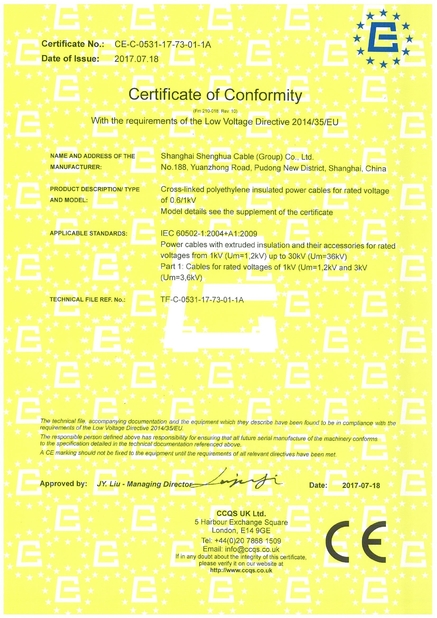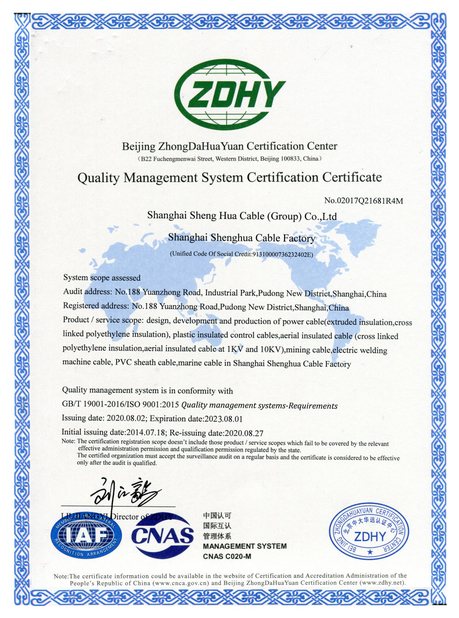
Kabel Shanghais Shenghua (Gruppe) Co., Ltd.
PVC building wire looks like the simplest product in the catalogue and causes a surprising share of site problems. The difference between solid BV, flexible BVR, H07V-K and THHN is not cosmetic: it changes pulling behaviour in conduit, termination method, bending radius and the temperature the finished circuit can tolerate. This guide explains the PVC building wire families, their voltage and temperature ratings, how to size lighting and socket circuits correctly once conduit fill and grouping are applied, and which mistakes most often cause warm terminals in residential and commercial installation. It ends with six answers on solid versus stranded, colour code and the limits of 1.5 mm2 and 2.5 mm2 circuits.

Building wire is a single core PVC insulated conductor intended for installation in conduit, trunking or a wiring accessory. It carries no outer sheath in the domestic sense, so its protection comes from the conduit and from the building fabric. The families differ mainly in conductor stranding and temperature rating.
| Type | Conductor | Voltage | Typical use |
|---|---|---|---|
| BV | Solid or 7 strand | 450/750 V | Fixed wiring in conduit |
| BVR | Fine stranded | 450/750 V | Long conduit runs, bends |
| H07V-K | Fine stranded | 450/750 V | Panel and equipment wiring |
| H05V-K | Fine stranded | 300/500 V | Control and signal |
| THHN | Stranded or solid | 600 V | North American conduit wiring |
All of these are PVC insulated and therefore limited to a 70 degrees Celsius conductor temperature. That limit is the same one that governs PVC power cable, and it matters in a ceiling void or a roof space where the ambient is far above the design assumption.
Most building wire failures are not manufacturing defects. They are mismatches between the wire chosen, the route it takes and the way it is terminated.
1. Solid wire in a difficult route. Solid BV is cheap and terminates neatly in screw terminals, but it does not tolerate repeated bending. Pulling solid wire around four 90 degree bends in a 20 mm conduit damages the insulation and work-hardens the copper, which then cracks at the terminal. BVR or H07V-K costs a little more and removes the problem.
2. Conduit fill ignored. A conduit holding three circuits of 2.5 mm2 has far less thermal capacity than a single circuit. Fill ratio and grouping derate the wire, and a socket circuit designed on the free air rating may run warm when the conduit is full and buried in insulation.
3. Voltage drop on long runs. In a large house or a warehouse, a 2.5 mm2 circuit at 80 m may satisfy the current requirement and still fail the voltage drop limit. The correction is usually a larger cross section for the last leg, not a different wire type.
4. Terminal compatibility. Fine stranded wire in a screw terminal without a ferrule can spread and loosen, creating a hot joint. Solid wire in a spring terminal designed for stranded can be under-clamped. Matching wire stranding to terminal type is a two minute decision that prevents most warm-terminal callbacks.
5. Colour and identification. Mixed colour conventions between the panel builder and the site electrician lead to swapped neutrals and unprotected earths. Agreeing the colour code in the specification prevents an error that is both dangerous and difficult to trace.
Begin with the circuit duty. Lighting circuits are typically 1.5 mm2, socket outlet circuits 2.5 mm2 and cooker or air conditioning circuits 4 to 6 mm2, subject to the national code and the actual load. Then check two things that are frequently skipped: voltage drop over the real route length, and the derating for conduit fill and ambient. A circuit that passes the current test and fails either of those is not compliant, however neatly it is installed.
Choose the stranding for the route. Short, straight runs in trunking are well served by solid BV. Long runs with multiple bends, and any wiring inside a machine or a panel, are better with BVR or H07V-K. Where the wire enters a screw terminal, use a ferrule on fine stranded conductor; where it enters a spring terminal, confirm the terminal accepts the stranding and the cross section range.
Plan the colour code before pulling. The protective conductor must be green-yellow along its entire length, never sleeved at the ends only, and phase and neutral colours should follow the local convention consistently across every distribution board. A simple colour schedule attached to the panel drawing saves hours of fault finding later.
Installation practice then determines whether the design survives. Keep pulling tension moderate, use lubricant in long conduit runs, and never pull wire through a conduit that already contains a sharp bend or debris. Leave sufficient slack at boxes for re-termination, but not so much that the wire is compressed when the accessory is fitted. Test insulation resistance and continuity before the accessories are installed, when a fault is easy to correct, and record the results per circuit.
| Circuit | Typical size | Wire type | Check |
|---|---|---|---|
| Lighting | 1.5 mm2 | BV or BVR | Voltage drop over run |
| Socket outlets | 2.5 mm2 | BV or BVR | Conduit fill and grouping |
| Cooker or AC | 4-6 mm2 | BVR, H07V-K | Terminal rating and torque |
| Panel wiring | 0.75-2.5 mm2 | H07V-K | Ferrules on all ends |
| Control and signal | 0.5-1 mm2 | H05V-K | Segregation from power |
Representative products include the PVC type ST5 sheathed copper core BV wire 500 V, the VDE standard PVC insulated cable in black for household installations, and the 1.5 and 2.5 mm2 single core wire for fixed wiring to H05V-K and H07V-K. Flexible building wire is covered by the BVR 1x4mm2 flexible oxygen free copper wire 450/750 V, and low smoke applications by the 450/750 V LSZH copper building wire. Where a defined temperature range is specified, the -20 to 70 degrees Celsius PVC insulated household cable is commonly used, and lighting circuits in large projects often specify the household LSZH PVC insulated cable for lighting.
Conduit wiring is thermally less generous than most designers assume. A conduit buried in thermal insulation, run through a hot roof space or packed with several circuits behaves very differently from a single cable in free air. Two practical rules keep the design safe. First, keep the total conductor cross section within the fill limit set by the local code, which is often around 40 percent of the conduit internal area, because a full conduit cannot dissipate much heat and cannot be re-wired later. Second, count the number of current carrying conductors in the same conduit and apply the grouping factor before finalising the size; four loaded conductors in one conduit can reduce the permissible current by 20 percent or more.
Bending is the other hidden constraint. Every conduit bend adds pulling friction, and a run with more than two 90 degree bends usually needs a draw box. Pulling solid wire through a long, bend-heavy route stretches the conductor and abrades the insulation, and the damage is invisible once the accessories are fitted. If the route cannot be simplified, use flexible BVR or H07V-K and reduce the pull length per drum so that the wire is not dragged around the whole run in one operation.
Three tests, performed before the accessories go on, catch nearly every installation defect. Insulation resistance between each conductor and earth, and between conductors, confirms that the PVC has not been damaged during pulling. Continuity of every protective conductor confirms that the earth path is complete to the last socket. Polarity and circuit identification confirm that the wire landed on the correct terminal at both ends, which is where colour discipline pays off.
Record the results per circuit, not as a single building figure, because a future fault is diagnosed by comparison. A circuit that reads several hundred megohms at handover and a few megohms three years later has a moisture or damage problem that is still cheap to fix; without the baseline, nobody knows whether the reading is normal for that installation. The same discipline applies to commercial fit-outs, where a small test record per floor becomes the reference document for the next refurbishment.
Almost all building wire failures trace back to four places. The first is the terminal: a loose screw, a missing ferrule or a mismatched clamp produces a hot joint that slowly cooks the insulation. The second is the box: too little slack means the conductor is under tension at the terminal, and too much means it is crushed when the accessory is screwed back. The third is the conduit entry: a sharp edge or a missing bush cuts the insulation where nobody looks. The fourth is the shared neutral: a borrowed neutral between two circuits leaves one circuit live when it appears isolated, which is a genuine safety hazard rather than an inconvenience.
Each of these is prevented by a simple habit. Torque terminals with a screwdriver that has a setting, use a bush at every conduit entry, leave a defined slack length, and never share a neutral between circuits unless the design explicitly requires it and the labelling makes it obvious. None of these habits costs money; all of them cost time on the first callback if they are skipped.
Packaging matters more than it appears for building wire. Coils of 100 metres suit domestic work and small sites, while spools of 500 or 1000 metres reduce handling on commercial projects and cut the number of joints in long runs. Specify the coil length, the labelling of each coil with type, size and colour, and whether the coil is shrink wrapped, because a coil that has absorbed moisture in a humid store will read low insulation resistance before it is even installed. These details are trivial at order stage and expensive to discover at first fix.
Neither is universally better. Solid wire terminates neatly and costs less; stranded wire pulls more easily through long conduit and tolerates bending. Match the wire to the route and the terminal.
450/750 V is the common rating for fixed wiring in conduit. Lighter 300/500 V wire such as H05V-K is intended for control and signalling, not for power circuits.
Only for very light duty and short runs, and it is not permitted for general socket circuits in most codes. 2.5 mm2 is the normal minimum for socket outlets.
Yes, when fine stranded conductor enters a screw terminal. Without a ferrule the strands spread, the clamp loosens and the joint overheats.
Both are PVC insulated single core wires, but THHN follows North American practice with a nylon jacket and a 600 V rating, while BV follows IEC and GB practice at 450/750 V.
Because a long circuit can satisfy the current rating and still deliver poor voltage at the far end, causing dim lights, motor overheating and premature equipment failure.
Building wire selection is a small decision with a long life. Match the stranding to the route, size for voltage drop as well as current, respect conduit fill and ambient, and agree the colour code before the first drum is opened. Those four habits eliminate most of the warm terminals and dim lights that keep electricians coming back to the same building. Shanghai Shenghua Cable Group manufactures BV, BVR, H05V-K, H07V-K and THHN style building wire in copper with standard, LSZH and heat resistant PVC compounds, packaged on coils or spools to project requirements. Send your circuit schedule and conduit design through our contact page and our engineers will return the wire type, size and colour schedule for each circuit.