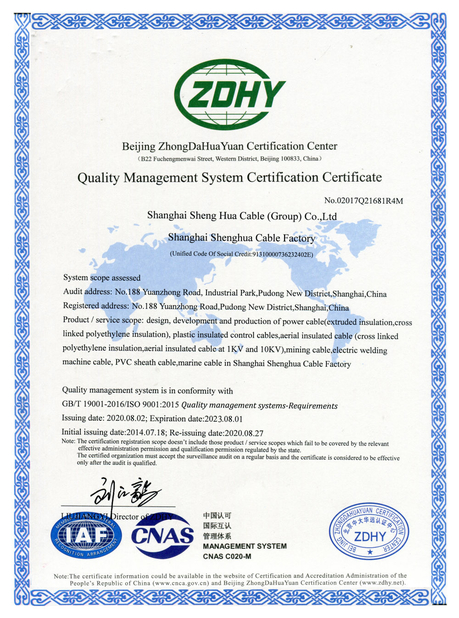
Kabel Shanghais Shenghua (Gruppe) Co., Ltd.

Die Auswahl des richtigen Kabelquerschnitts ist ein Eckpfeiler für sichere, effiziente und kostengünstige elektrische Systeme.die kurzfristig funktionieren können, aber zu Überhitzung führen können, übermäßiger Spannungsabfall oder frühzeitiger Isolationsfehler.
Shenghua Cable (Shanghai Shenghua Cable Technology Group Co., Ltd.), mit jahrzehntelanger Erfahrung in der Kabelherstellung und internationalen Projekten, teilt vier wissenschaftliche Ansätze zur Auswahl von Kabelquerschnitten für verschiedene Anwendungen.
Hier finden Sie die Produkte von Shenghua Cable:Die Kommission erläuterte, dass die Kommission die von der Kommission vorgelegten Informationen nicht berücksichtigt hat.
Kabel sind so konzipiert, daß sie einen bestimmten Strom tragen, ohne ihre langfristige zulässige Temperatur zu überschreiten.
PVC-Dämmung:maximal 70°C
XLPE-Dämmung:maximal 90°C
Beispiel:
Transformator: 2500 kVA, Versorgung mit 10 kV
Kabeltyp: XLPE, installiert in einer Kabelbrücke
Schritt eins:Berechnung des Nennstroms
I=250010.5*1.732≈137AI = frac{2500}{10.5 mal 1.732} ca. 137A
Schritt 2:Überprüfen Sie den Kabelkatalog
YJV-8.7/10KV-3X25 → 120A
YJV-8.7/10KV-3X35 → 140A
Schritt 3:Kabel auswählen
YJV-8.7/10KV-3X35 trifft 137A sicher
Tipp:Bei der Anwendung dieses Ansatzes sind immer die Umweltbedingungen und die Installationsmethode zu berücksichtigen.
Diese MethodeMaterialkostenundEnergieeffizienzDie Wahl eines zu kleinen Kabels erhöht die Verluste, während zu große Kabel die Investition unnötig erhöhen.
Verfahren:
Bestimmung des Nennstroms der Ausrüstung
Berechnung der jährlichen Betriebsstunden
Suchen Sie nach der Wirtschaftsstromdichte (A/mm2) für diese Stunden
Strom der Ausrüstung durch die wirtschaftliche Dichte aufteilen, um den Querschnitt zu bestimmen
Beispiel:
Ausrüstungstrom: 150A
Betrieb: 8000 Stunden/Jahr
Wirtschaftliche Dichte: 1,75 A/mm2
S=1501,75≈85,7 mm2S = frac{150}{1,75} ca. 85,7 text{ mm2}
Schritt 2:Wählen Sie die nächste Standardgröße → 95 mm2
Dies sorgt für eine kostengünstige Kabelgröße mit minimalem Stromverlust.
Lange Kabelläufe können einen erheblichen Spannungsrückgang erleiden, der sich auf die Leistung und Effizienz sensibler Geräte auswirkt.≤ 7% für Niederspannungssysteme (400V).
Formel für Spannungsrückgang:
S=I⋅ρ⋅LΔUS = frac{I cdot rho cdot L}{Delta U}
II)Ich...= Nennstrom
Rhrhρ= Leiterwiderstand (Ω·mm2/m)
LLL= Kabellänge (m)
ΔUDelta UΔU= zulässiger Spannungsabfall
Beispiel:
Spannung des Geräts: 380V
Nennstrom: 150A
Kabellänge: 600 m
Kupferwiderstand: 0,0175 Ω·mm2/m
Zulässiger Abfall: 26,6 V
S=150*0,0175*60026.6≈59.2 mm2S = frac{150 mal 0,0175 mal 600}{26.6} ca. 59,2 text{ mm2}
Schritt 2:Wählen Sie die nächstgelegene Standardgröße → 70 mm2
Dies sorgt für eine stabile Spannung am Endgerät.
Bei Hochspannungssystemen müssen Kabel der thermischen Wirkung von Kurzschlussströmen standhalten, ohne die Isolierung zu beschädigen.
Formel:
Smin_=IdtiCS_{min} = frac_{I_d sqrt_{t_i}}{C}
EinheitlichIch...d- Ich weiß.= Kurzschlussstrom
Titel ItIch- Ich weiß.= Betriebsdauer des Brechers
CCC= Wärmefaktor des Kabels (80)
Beispiel:
Kurzschlussstrom: 18 kA
Bremserzeit: 0,25 s
Smin=18000*0.2580≈112.5 mm2S_{min} = frac{18000 mal sqrt{0.25}}{80} ca. 112.5 text{ mm2}
Schritt 2:Wählen Sie die nächstgelegene Standardgröße → 120 mm2
Selbst bei geringen Geräten muss das Kabel kurzschaltende Ströme sicher übertragen.
Shenghua Kabelenthält:
mit einer Breite von nicht mehr als 50 mm,
Verstärkte Verkleidungen zum mechanischen und umweltbezogenen Schutz
Einhaltung internationaler Zertifizierungen
Technische Leitlinien für die projektspezifische Kabelgröße
Diese Funktionen sorgen dafür, dass Ihr elektrisches Systemsicher, effizient und langlebig.
Besuchen Sie unsere Website für technische Spezifikationen und Projektunterstützung:Die Kommission erläuterte, dass die Kommission die von der Kommission vorgelegten Informationen nicht berücksichtigt hat.
Die Auswahl des Kabelquerschnitts ist eine mehrdimensionale Entscheidung.
Langfristige Stromkapazität
Wirtschaftsströmungsdichte
Spannungsabfall
Wärmestabilität bei Kurzschluss
Ingenieure können optimale Sicherheit, Effizienz und Wirtschaftlichkeit erreichen.
Shenghua Kabelkombiniert hochwertige Materialien mit technischem Know-how, um zuverlässige, langlebige Kabellösungen für Industrie-, Energie- und Infrastrukturprojekte weltweit bereitzustellen.